Artelize - A Symphony of Culture: Exploring the 2025 European Classical Music Festivals
main-artelize-logo

Loading...

Featured

A Symphony of Culture: Exploring the 2025 European Classical Music Festivals

As the calendar flips to 2025, Europe's classical music scene is set to dazzle audiences with a series of remarkable events. From the depths of Baroque masterpieces to the vibrant tones of 20th-century compositions, these festivals bring together maestros, singers, and orchestras in a celebration of musical artistry. With performances spanning Halle to Leipzig, each event promises a unique journey through the historical and cultural tapestry of music. Join us as we explore these captivating concerts, each with its own story to tell.

May 30, 2025
frame icon Share
titleImage
Jun 5, 2025
Staatskapelle Halle

Halle (Saale) · Dom zu Halle

2. Alexander's Feast
Kicking off this “Italian” Handel Festival is the historic revival of the first Italian version of Alexander’s Feast. It was an English Lord who infected the Grand Duke of Tuscany – later Emperor Leopold II – with a love of Handel’s oratorios. On 21 April 1768, the first ever performance of Alexander’s Feast on the continent took place in Lord Cowper’s villa outside the gates of Florence, followed two days later by a performance
titleImage
Jun 5, 2025
Händel-Festspiele Halle

Halle · Halle Cathedral

titleImage
Jun 8, 2025
Staatskapelle Halle

Marktplatz Halle

4. F. A. Urio: Te Deum
In Italy, a whole new world opened up to Handel and the Te Deum by Francesco Antonio Urio was part of it. Urio’s compositions enthused the young man from Halle so much that he drew inspiration from them for several of his own works. For example, he borrowed sections from the Te Deum for his oratorio, Saul. Baroque legend Reinhard Goebel, together with the MDR Radio Choir and Staatskapelle Halle, gives us another opportunity to hear this profound piece of music.
titleImage
Jun 8, 2025
Händel-Festspiele Halle

Halle (Saale) · The Market Church

5. Kantaten
Leopold Stokowski, a great admirer of Bach, examined his works under the microscope and, with the aid of modern instruments, "magnified" the Baroque master's sound world into an orchestral experience. Taneyev, on the other hand, demonstrated an affinity for historical compositional styles, whose polyphonic compositional artistry even inspired admiration from his teacher Tchaikovsky. The cantata, little known in this country, tells of the last hours of John of Damascus in a haunting choral-symphonic movement. In contrast, Shostakovich chose a very secular theme for his cantata, which, in a historicizing way, was a parable of the brutal oppression in his time.
titleImage
Jun 15, 2025
MDR-Sinfonieorchester

Leipzig · Gewandhaus

6. Creation
Never has the creation of the world been captured in music in a more vivid and exciting way: Joseph Haydn's entire compositional artistry, skill, and innovative power flowed into his creation. It reflects the ideas of the Enlightenment, whose focus is no longer God, but rather humanity as a mature being. While influences from Handel are evident musically, Haydn's orchestral treatment already reaches into 19th-century realms. With this concert, Josep Vila i Casañas assumes his position as the new Chief Conductor of the MDR Radio Choir.
titleImage
Sep 14, 2025
MDR-Sinfonieorchester

Leipzig · Gewandhaus

7. Love & Damnation
His era's enthusiasm for the oratorio genre also inspired Antonín Dvořák, who significantly advanced the national tone poem in this genre. The plot of The Ghost Bride is taken from a popular ballad by the Czech poet Karel Jaromír Erben: A pious girl longs to be reunited with her lover, who was lost in the war. Having fallen in battle, the latter seeks her out as an undead bridegroom and attempts to lead the bride to eternal damnation. Seemingly on her way to him, she is gradually forced to discard all signs of her faith. But in the end, her faith prevails and saves her from the realm of the dead.
titleImage
Sep 28, 2025
MDR-Sinfonieorchester

Leipzig · Gewandhaus

8. Verzweifle nicht!
In 1852, Robert Schumann composed the Missa sacra for church services – a work that expresses not a denominational but a universal religious sentiment. The motet "Do Not Despair," initially described by Schumann as a "religious hymn," was first performed on July 4, 1850, for a secular occasion – the 25th anniversary of the St. Pauli University Choir in Leipzig. Haydn's Fifth London Symphony demonstrates the composer's independence from courtly taste and circumstances: He presents this work with pathos, earnestness, passion – and, unusually, in a minor key – thus forging a programmatic link back to Schumann.
titleImage
Nov 23, 2025
MDR-Sinfonieorchester

Leipzig · Gewandhaus

9. A Thousand Stars
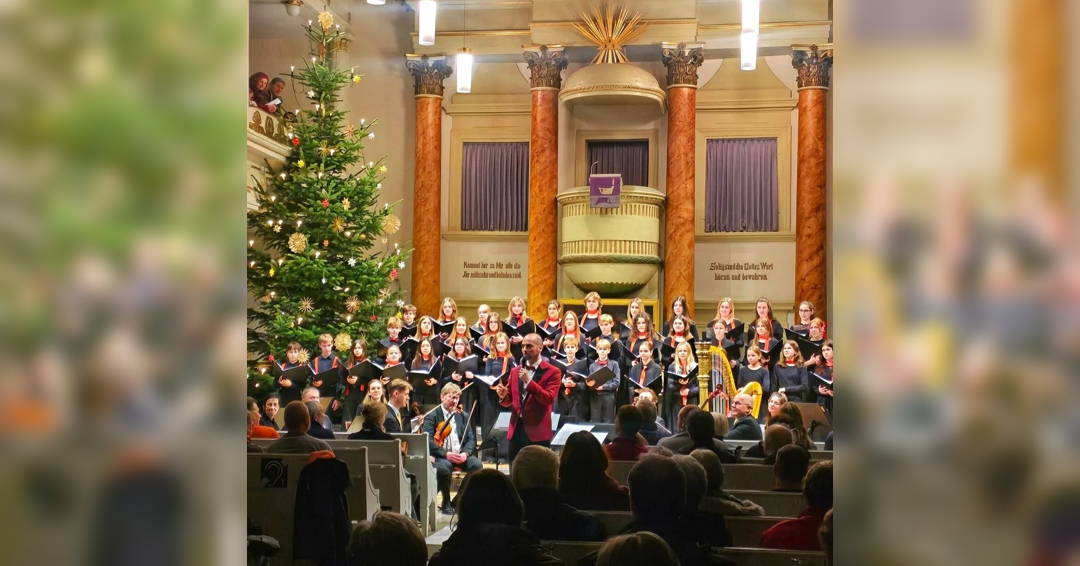
When the first candle burns on the Advent wreath and bright strings of lights begin to glow in the windows, when the calendar doors are gradually opened and the kitchen smells of cinnamon stars, gingerbread, and almond cookies – then it's Advent. And, of course, familiar Christmas melodies also put us in the mood for the festive season. That's why the MDR Children's Choir is touring with concerts, especially in the run-up to Christmas. For many years, it has been a tradition for the MDR Children's Choir to awaken anticipation of Christmas in its broadcast area with cheerful, contemplative songs.
titleImage
Nov 30, 2025
MDR-Sinfonieorchester

Zeulenroda-Triebes · Dreieinigkeitskirche Zeulenroda

10. ¡Navidad!
Josep Vila i Casañas, the new chief conductor of the MDR Radio Choir, captures the spirit of Christmas with music from various regions of Spain. The main work of the concert is "Nit de Nadal" (Christmas Eve), an oratorio by one of Catalonia's most important composers and musicians, Joan Lamote de Grignon. He composed it at the turn of the 20th century based on poems by the Catalan composer Francesc Casas i Amigó, combining folk music elements with a post-Wagnerian style to create a moving, musically late-Romantic narrative about the events of Christmas Eve.
titleImage
Dec 25, 2025
MDR-Sinfonieorchester

Leipzig · Gewandhaus

Conclusion
As these events unfold across Europe, we are reminded of the enduring legacy and transformative power of classical music. Each concert is a testament to the rich tapestry of history, culture, and artistic innovation. From the heartfelt choral performances at the Händel-Festspiele to the symphonic narratives at Gewandhaus, these festivals offer a profound connection to the music's past while inspiring new appreciation for its future. Whether you're a seasoned aficionado or a curious newcomer, the 2025 classical music season promises an unforgettable journey through the world of sound.
frame icon Share
2026 Artelize